

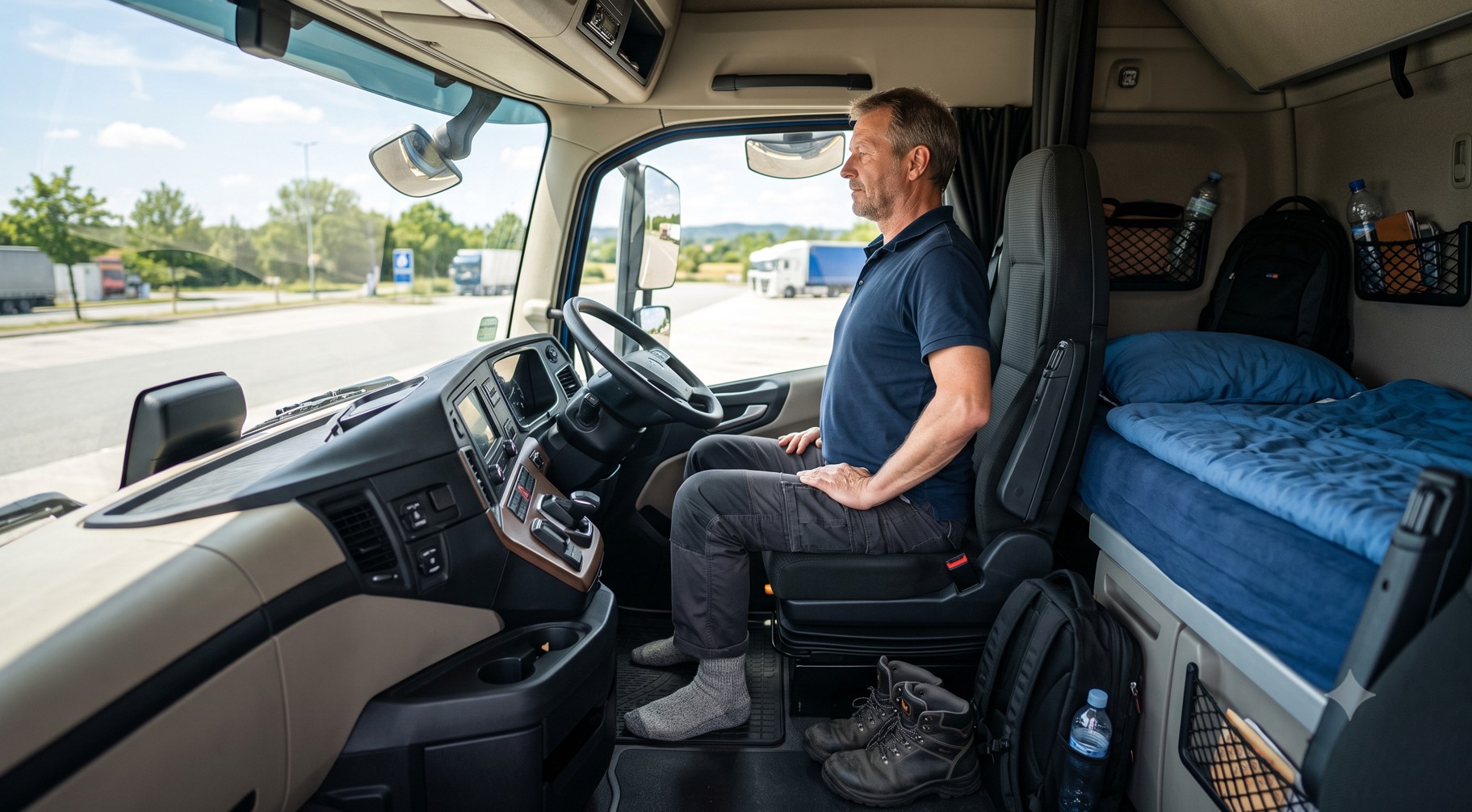
Sitting for 9 hours straight compresses your lumbar spine by up to 1.1cm and increases pressure on your lower back discs by 40% compared to standing. As a long-haul driver, you already know this—you feel it every time you climb out of the cab after a full shift. The good news: targeted exercises done during mandatory rest breaks can reduce chronic back pain by 25-40% within six weeks, according to research from the European Agency for Safety and Health at Work. Here are the specific movements you can do without leaving your truck.

Why Truck Drivers Get Back Pain (And Why It Gets Worse)
Your spine wasn’t designed for the seated position. When you sit, your hip flexors shorten and tighten, pulling your pelvis forward. Your glutes—the muscles that should be stabilizing your lower back—essentially switch off. Add vibration from the road surface, and you’ve got a recipe for disc degeneration that accelerates with every kilometer.
A 2022 study by the Finnish Institute of Occupational Health found that professional drivers experience lumbar disc problems at 2.3 times the rate of the general working population. German occupational health statistics show that musculoskeletal disorders account for 23% of all sick days among commercial vehicle operators—the highest single cause.
The problem compounds over time. Drive for five years without intervention, and the cumulative damage becomes harder to reverse. But here’s what most health advice misses: you can’t just “stretch more.” You need specific movements that counteract the exact postures you hold for hours. And you need to do them in the space you actually have—your cab.
Cab-Friendly Exercises for Your Lower Back
These four movements target the muscles that suffer most during long drives. You can do all of them in under 10 minutes during your 45-minute rest break required under EC 561/2006 driving time regulations.
Seated Pelvic Tilts
Sit on the edge of your bunk or passenger seat with feet flat on the floor. Slowly roll your pelvis forward, arching your lower back, then roll it backward, flattening your back against an imaginary wall behind you. Move smoothly between these two positions.
- Do 15-20 repetitions, taking about 3 seconds for each complete forward-and-back cycle to really feel the movement in your lower spine.
- Focus on the movement coming from your pelvis, not from hunching your shoulders or moving your upper body.
- This exercise rehydrates your intervertebral discs by creating a pumping action that draws fluid back into the compressed areas.
Standing Hip Flexor Stretch
Step out of your cab for this one—you need to stand. Place one foot on your fuel tank step or a low surface. Keep your back leg straight and push your hips forward until you feel a stretch in the front of your rear hip. Hold for 30 seconds each side.
- Your hip flexors (the psoas and iliacus muscles) shorten dramatically during driving, pulling your pelvis into a position that strains your lower back.
- Squeeze your glute on the stretching side to deepen the stretch and activate the muscles that have been dormant.
- Do this stretch every time you fuel up—it takes less time than filling a 400-liter tank.
Seated Spinal Twist
Sit sideways on your seat or bunk. Cross one leg over the other, place your opposite elbow on the outside of your raised knee, and rotate your torso toward the back of the cab. Hold 20-30 seconds, then switch sides.
- This rotation decompresses the facet joints along your spine that get locked in a forward-facing position for hours.
- Breathe deeply into the stretch—exhaling allows your muscles to relax further into the rotation.
- Avoid bouncing or forcing the movement; gradual pressure works better than aggressive twisting.
Cat-Cow on Your Bunk
If your cab has a sleeper, get on all fours on your mattress. Arch your back toward the ceiling like an angry cat, tucking your chin to your chest. Then drop your belly toward the mattress, lifting your head and tailbone. Alternate between these positions smoothly.
- Perform 10-15 cycles, spending about 2 seconds in each position to give your spine time to move through its full range.
- This mobilizes every segment of your spine, not just the lower back, and helps maintain flexibility in areas that get rigid from sitting.
- If you don’t have a sleeper, you can do a standing version by placing hands on your thighs and rounding/arching your back.
Building a Realistic Exercise Routine Around Your Rest Periods
Knowing the exercises is one thing. Actually doing them consistently is another. The drivers who succeed build these movements into their existing schedule rather than trying to create separate “workout time.”
| Rest Period | Duration Available | Recommended Exercises |
|---|---|---|
| 15-minute break | 5 minutes for exercise | Pelvic tilts (2 min) + Standing hip flexor stretch (3 min) |
| 45-minute break | 10-15 minutes for exercise | Full routine: all four exercises plus walking around the truck park |
| Daily rest (11 hours) | 20-30 minutes | Complete routine plus additional glute bridges and planks if space allows |
| Weekly rest (45 hours) | Flexible | More intensive stretching or gym visit at larger truck stops |
Under the updated tachograph regulations taking effect in 2026, your rest periods will be tracked more precisely than ever. Use that structure to your advantage—set a phone alarm for 5 minutes into each break to remind yourself to move.
Equipment That Actually Helps (And What’s a Waste of Money)
The truck accessory market is full of products claiming to solve your back problems. Some work. Most don’t. Here’s an honest breakdown based on what drivers actually report helps.
Worth the Investment
- Lumbar support cushions with adjustable firmness can reduce lower back strain by maintaining your spine’s natural curve—but only if you actually use them, which means they need to stay in place without constant readjustment.
- Resistance bands (€10-15) let you do strengthening exercises in your cab, targeting the glutes and core muscles that support your spine.
- A foam roller (travel-sized versions exist) provides self-massage for your back and legs, breaking up muscle tension that accumulates over days on the road.
Skip These
- Vibrating massage seat covers sound good but typically aren’t powerful enough to penetrate the deep muscles that need attention after hours of driving.
- “Posture corrector” straps might work for office workers but become uncomfortable and impractical under a seatbelt within minutes.
- Expensive ergonomic seat replacements often aren’t compatible with your specific truck model and may void warranty or cause issues during inspections.
When to See a Professional
Exercise helps prevent and manage most back pain. But some symptoms require medical attention. Don’t ignore these warning signs:
- Pain that radiates down your leg below the knee, especially with numbness or tingling, may indicate a herniated disc pressing on a nerve.
- Sudden severe pain after a specific incident (lifting, twisting, or even just stepping out of the cab wrong) needs assessment to rule out acute injury.
- Back pain accompanied by unexplained weight loss, fever, or loss of bladder/bowel control requires immediate medical evaluation.
- Pain that doesn’t improve at all after two weeks of consistent stretching and exercise should be examined by a physiotherapist or doctor.
In Germany, occupational health services (Betriebsarzt) are legally required for transport companies with more than one employee. In France, the médecine du travail provides free consultations. Use these services—they exist specifically for situations like yours. Staying alert and healthy on long routes requires addressing problems before they become career-ending—other factors affect your physical condition too, but back pain is often the first domino to fall.
Frequently Asked Questions
How often should truck drivers stretch to prevent back pain?
Aim for movement every 2-3 hours at minimum, which aligns with your mandatory driving break schedule. Even 5 minutes of targeted stretching during a short break makes a measurable difference. Research from Sweden’s Karolinska Institute found that drivers who stretched during every rest period reported 34% less back pain than those who only stretched at the end of their driving day.
Can I do back exercises while driving?
Simple pelvic tilts and glute squeezes are safe to do while driving on straight, clear motorways. Anything that requires you to take your hands off the wheel, close your eyes, or shift your body position significantly should wait for a stop. Seated pelvic tilts—gently rocking your pelvis forward and back—can be done without affecting your driving, and many physiotherapists recommend them every 30-45 minutes.
What’s the best sleeping position for truck drivers with back pain?
Side sleeping with a pillow between your knees keeps your spine aligned and takes pressure off your lower back. If you sleep on your back, place a rolled towel or small pillow under your knees. Avoid sleeping on your stomach—this forces your neck into rotation and increases lumbar strain. The mattresses in most sleeper cabs compress over time, so adding a 5cm memory foam topper can significantly improve your sleep quality.
Should I use heat or ice for truck driver back pain?
For general stiffness and muscle tension after driving, heat works better—it increases blood flow and relaxes tight muscles. A microwaveable heat pack (you can warm it at truck stops with hot water if no microwave is available) applied for 15-20 minutes is effective. Use ice only if you have acute inflammation after a specific injury—swelling, redness, or sharp pain that came on suddenly. Most chronic driving-related back pain responds better to heat.
Are standing desks or steering wheel attachments worth it for back health?
Standing desks designed for truck cabs exist but aren’t practical for most drivers—you need to be seated to operate the vehicle. Steering wheel laptop trays or phone holders don’t affect your back health directly, but they can encourage poor neck posture if positioned incorrectly. The most effective investment for back health remains a quality lumbar support cushion and the discipline to actually do your stretches during breaks.