
Faced with a medical laboratory report filled with abbreviations and numbers, a professional long-haul driver might feel puzzled, almost as if staring at a foreign map without a key. Keeping healthy behind the wheel is just as important as keeping a lorry moving, but sometimes that tangle of medical terms can make anyone uneasy. Actually, with just a little help, understanding your blood test results quickly becomes manageable; think of it as reading your body’s own performance report to help you steer clear of health problems on any road.
Decoding your body’s dashboard report
Oddly enough, many professional drivers get accustomed to scanning their lorry’s dashboard for trouble long before they pay attention to a medical report. The dashboard immediately shows problems with oil, water, or temperature, essential checks for safety. Your routine blood test is, in a way, just as important. It is your body’s early warning and information system, although, admittedly, the details might not seem clear at first glance.
In places like the UK, government authorities request that lorry, bus, or coach drivers complete a medical evaluation when renewing a licence after age 45. Still, it’s helpful to know that blood tests are not automatic at each renewal; your own GP will determine what makes sense for you based on your health and role. Interpreting test results is not about getting a grade or paying a penalty. Each number acts more like an indicator, alerting your doctor to patterns and possible issues, much like you’d ask a mechanic about a recurring dashboard light. Rather than guessing, focus on understanding what each key word means, and remember: your doctor is there for expert interpretation. You can gain a solid understanding, but it’s your medical team that ultimately steers the decisions.
For peace of mind, a little health knowledge goes a long way, similar to how a familiar dashboard keeps you confidently on the road.
Section 1 ( The blood count (your internal oxygen & defense team)
Among the most common and practical blood tests is the full blood count (FBC), which reviews the different parts that make up your blood. Imagine your bloodstream as a busy logistics company, moving essential goods everywhere, each team member plays a critical part in daily operations.
- Red Blood Cells (RBC) quietly handle oxygen deliveries, carrying fuel to your muscle and organs. Should you find these numbers low, it could explain persistent tiredness, much like a vehicle running low on fuel.
- Haemoglobin acts like a dependable set of straps securing cargo; it makes sure the oxygen remains attached until it arrives at its destination.
- White Blood Cells (WBC) make up the body’s vigilant guards, always ready to identify and deal with bugs, bacteria, or any harmful intruders making their way onto your internal routes.
- Platelets serve as quick-response repair teams, patching up leaks or cuts so you avoid losing vital fluids, similar to how a road crew fills potholes to keep traffic moving.
For a clearer breakdown, here’s a table summarising each function:
| Blood component | Truck analogy | Main job |
|---|---|---|
| Red Blood Cells (RBC) | Delivery trucks | Transport oxygen to muscles and organs |
| Haemoglobin | Cargo straps | Secure the oxygen inside the delivery trucks |
| White Blood Cells (WBC) | Security force | Fight off infections and clear damage |
| Platelets | Emergency repair crew | Seal cuts and stop bleeding |
Of course, this is just a snapshot, but it’s a useful way to appreciate how hard your blood works on your behalf, quietly, effectively, every day.
Section 2 ( The lipid panel (your fuel & oil quality)
Looking beyond red cells and defence teams, your lipid panel offers a check of the “fuel and oil” that your body runs on. The fats found in your blood, like cholesterol and triglycerides, help you function, but it’s their proportions, not just their presence, that matter.
- Total Cholesterol gives an overall figure for the fatty substances in your blood; it’s much like estimating the total oil running through your engine. This figure is a quick overview, but it hides variety within.
- HDL (High-Density Lipoprotein) works like a specialised cleaning team, carrying excess fat away from vessel walls to your liver for disposal. You want a strong HDL crew on your side, as they keep your “pipes” clearer.
- LDL (Low-Density Lipoprotein) acts as a busy fleet of delivery vehicles shipping fat around. Without proper control, LDL can leave behind a sticky residue inside your arteries, building up plaque that gradually narrows blood flow.
- Triglycerides are the main storage tanks of unused energy. When the load is too heavy for too long, higher triglyceride levels signal your body’s “fuel reserves” might need emptying with a more active routine or healthier diet.
Remember, cholesterol is essential for cell health, whereas triglycerides reflect stored energy. Doctors typically review these markers separately for a more reliable view of your general well-being. Marco Polo Mobile recognises that drivers benefit from clear distinctions and straightforward health advice.
Balanced lipid results help your doctor understand your risk for issues like heart trouble, so making sense of these terms can honestly help you ask smarter questions at check-ups.
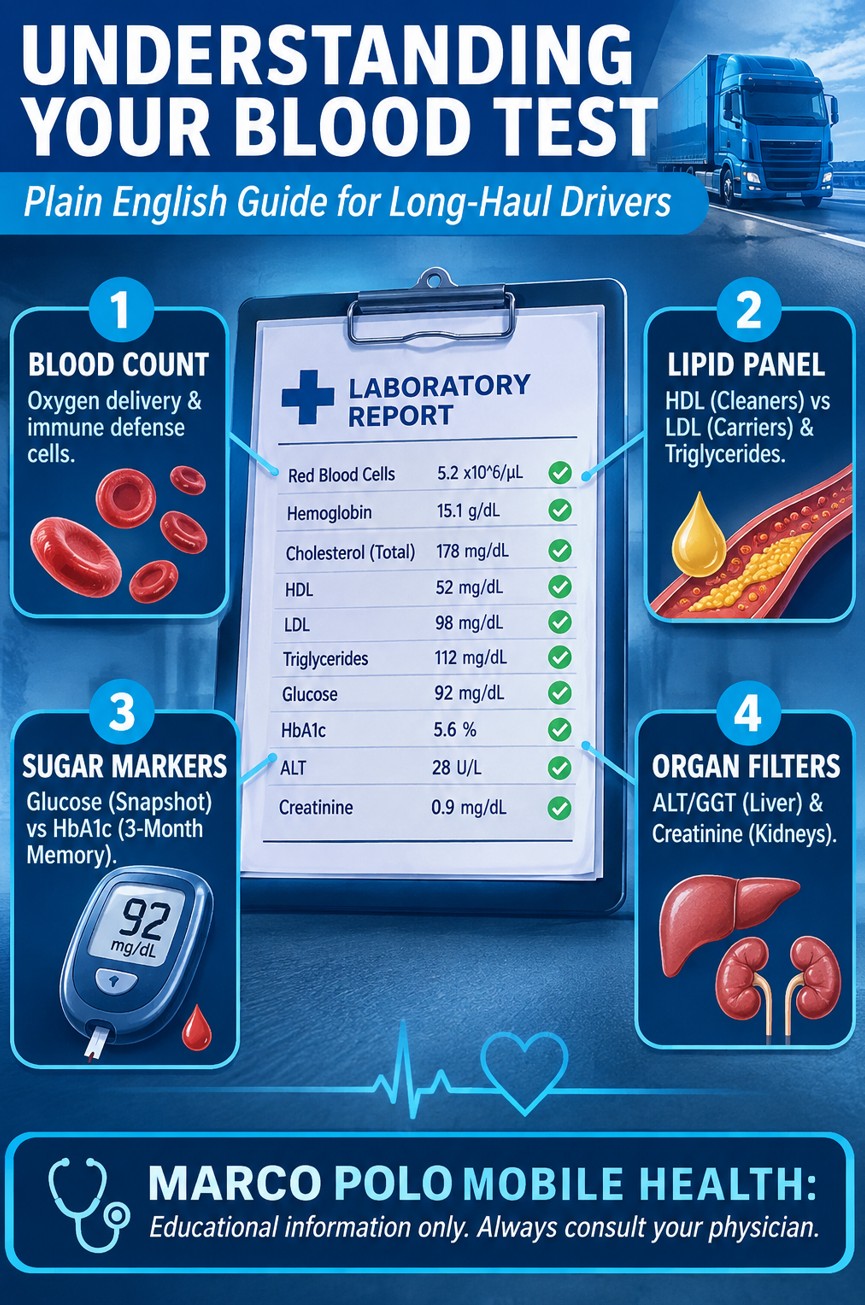
Section 3 ( Glucose and HbA1c (your blood sugar memory)
Stable blood sugar holds important meaning if you spend long stretches driving or waiting on the road. Two primary markers provide a slightly different view of how your body is managing sugar.
First comes fasting glucose: this measures the level of sugar in your blood at that particular moment, usually after a quiet night’s rest with no food or beverages except water. It’s similar to checking your lorry’s speedometer after parking, it tells you where things stand right now.
Then there’s HbA1c (glycated haemoglobin): this measurement looks further back in time, averaging out what your blood sugar has been doing across two or three months. You might compare it to a data logger continuously tracking a truck’s mileage, smoothing out the highs and lows for a steady trend. Since red blood cells live for several months, this reading points out overall management, not just a snapshot.
If you can picture your body as a complex system needing reliable oxygen, good oil, and even energy delivery, you are well on your way to understanding what these core results mean.
Continue reading Part 2: Liver, Kidneys, and Doctor Visit Preparation
The Marco Polo Mobile guarantee: Tested for the cabin
At Marco Polo Mobile, our team promises to deliver clear and practical health guidance designed specifically for professionals who spend long hours on the road. Everything is crafted to be direct and free of unnecessary technical terms, showing true respect for your time.
Every fact in this article is checked for real-world usefulness. When we say “Tested for the Cabin”, we mean that our advice works in the real settings where drivers live and work, aligning helpfully with your schedule and break requirements. Our focus is on education, never diagnosis; we want you to understand basic health information relevant to your unique work life. Marco Polo Mobile remains committed to honest and realistic content fit for anyone who depends on long-haul travel.
Frequently asked questions (FAQ)
What is the main difference between fasting glucose and an HbA1c test?
Fasting glucose offers an exact count of blood sugar after a period with no food, acting as a single-time check. On the other hand, HbA1c averages your blood sugar levels over several weeks, acting a bit like a summary report of your blood sugar’s recent past. There is no need to fast for the HbA1c sample.
Why are liver enzymes like ALT and GGT included in a routine driver check-up?
Liver enzyme readings provide early clues about how well your liver is keeping up with its workload, clearing away what you eat or drink. Sometimes your medical provider adds these tests based on your health background, symptoms, or lifestyle, it’s not automatic for every check, but it helps if there’s reason for a closer look.
What does HDL cholesterol do compared to LDL cholesterol?
HDL acts as a reliable clean-up team, returning excess fat from your arteries to the liver for processing. LDL, however, serves as an eager delivery service, moving cholesterol to various parts of your body. If too much LDL is around, it can build up inside your blood vessels, but strong HDL levels help balance this risk.
Join the connected driver community
Professional drivers often work alone, and discussing health checks with others brings useful perspective and ease.
Have you ever been unsure about a medical result or felt lost reading abbreviations? Which part was the biggest challenge to understand? Please feel welcome to share your experience in the comments below.
This is a safe space to talk openly about confusing terms such as “HDL” or “HbA1c”. Please protect your privacy by not posting your test figures, photos, or any other personal details. Whenever you have a question specific to your results, the safest way is always to reach out to your doctor.
Important medical notice
As part of Marco Polo Mobile’s commitment, we put clarity and responsibility first when discussing your health.
MEDICAL DISCLAIMER: The information here is strictly for educational and informational use. It does not replace the advice, diagnosis, or treatment from a healthcare professional. Always consult your doctor or a certified provider about any health issue or goal.
The path to protecting your health behind the wheel starts with learning to read the key signs your body gives you. Gaining familiarity with your body’s “dashboard” changes a confusing medical statement into a practical resource for well-being as you travel near and far.
When you next meet with your doctor to talk through a medical report, you’ll have the key questions ready, and a better sense of how daily choices influence your health. Working together, you and your doctor can help keep your engine running smoothly, ensuring that every journey ahead is as safe and healthy as possible.