

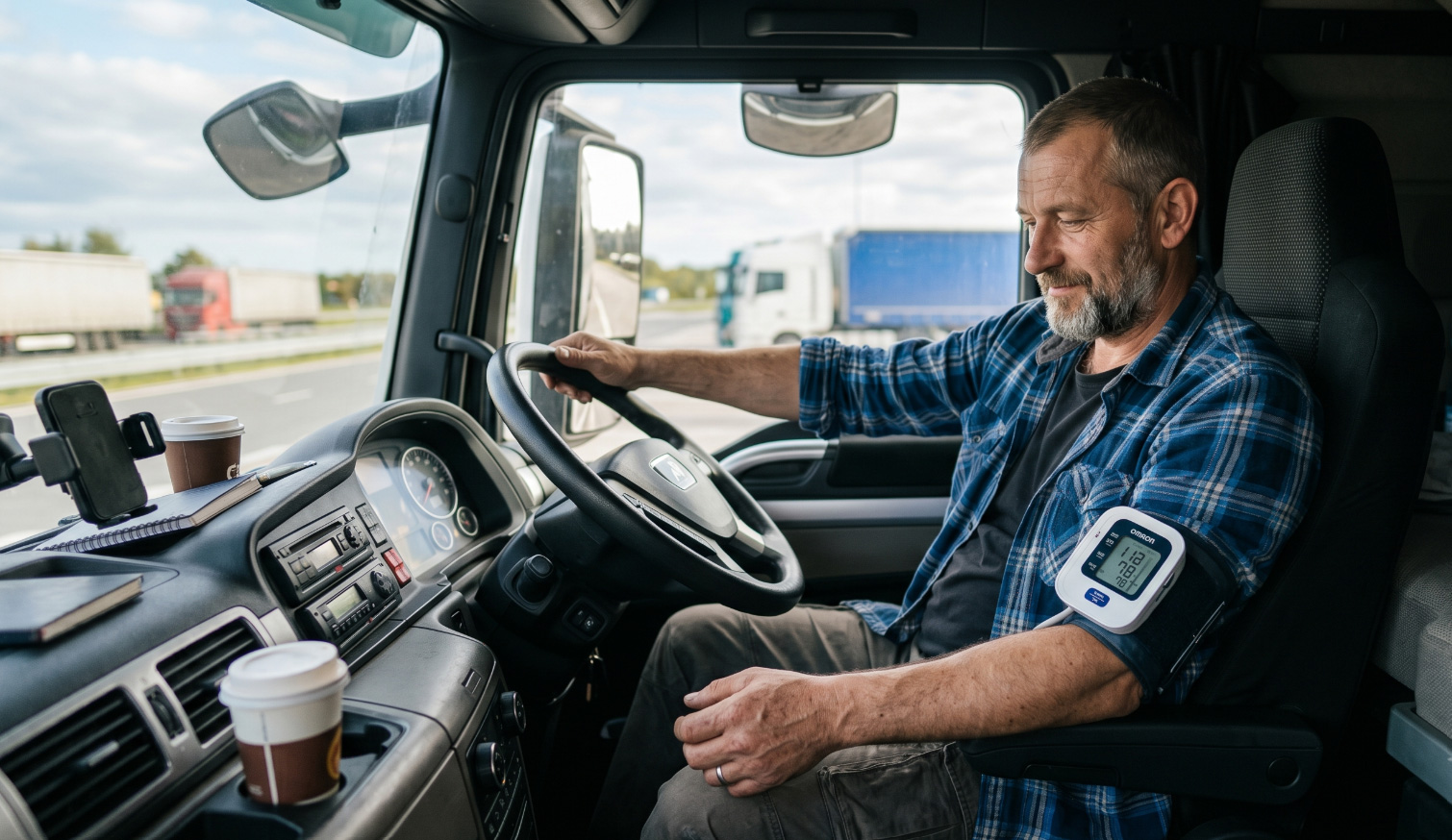
When you spend many hours behind the wheel, traffic doesn’t help, and delivery deadlines are burning, it is common for coffee to be your best copilot.
Sounds like a daily routine, right?
The problem is that all that pressure isn’t just taken on by the truck’s engine ; your heart takes it on too.
High blood pressure is known as the “silent killer” because it doesn’t give any warning, it doesn’t hurt, but it wears down your arteries mile by mile.
Since spending weeks on the road makes it hard to go to the doctor for a checkup, the solution is right where most of the workday takes place: the cab.
Today, we will show you how to check your blood pressure yourself—easily, quickly, and without losing any route time.
The enemy in the seat: Why does our blood pressure rise while driving?
Sitting for more than eight consecutive hours increases the stiffness of blood vessels, whether we are drivers or office staff.
If we add to that the stress spikes in our industry—for example, when a load is delayed—the body releases cortisol, a hormone that spikes blood pressure and is known as the “stress hormone”.
Controlling this isn’t a whim; it’s the difference between being able to retire in good health or suffering a scare in the middle of a trip.
The 3 mandatory steps before pressing the button
Measuring blood pressure in a truck has a trick to it..
It does no good to pull over at a service area and immediately put on the blood pressure monitor.
Doing it that way guarantees an unreliable result. The reading will skyrocket and can give you a scare when there’s no reason for it.
We need to keep it simple.
Let’s follow this three-step routine:
- Turn off the engine and breathe: The truck’s vibrations while idling confuse digital devices.
- Park, turn off the engine, and sit in silence for 5 minutes so your body can stabilize.
- Watch out for caffeine: Don’t measure your blood pressure if you’ve just had a coffee or an energy drink.
- Wait at least 30 minutes from your last sip.
- The right posture: Plant your feet firmly on the cab floor (don’t cross them).
- Place your left arm on the steering wheel or folding table so that the cuff sits at the height of your heart.
Now you’re ready!
Your digital First-Aid Kit: Let’s keep it simple, easy, and cheap
Does the image of old-school bulb blood pressure monitors and stethoscopes come to mind? Yes. Well, on the road we need speed… to check our blood pressure easily and cheaply.
Get yourself an automatic digital arm monitor that fits in the glove compartment (wrist ones are more comfortable, but they act up more if you move).
A single measurement doesn’t mean anything; ideally, you should measure it twice a week.
You don’t need to carry a piece of paper that could get lost among your delivery notes ; use a small notebook in the glove compartment or download a free app on your phone to track the numbers.
Warning: If you see that your maximum pressure regularly exceeds 140 or the minimum goes over 90, it’s time to take advantage of your next stop back home to book an appointment with your doctor.
Your truck doesn’t head out on a route without passing an inspection, right? Well, neither should your body. Taking care of your blood pressure ensures that you’ll stay behind the wheel for many more years.
What about you? Do you carry a blood pressure monitor in the cab, or has it been months since you last checked it? Tell us about your experience in the comments.
MEDICAL DISCLAIMER:
The information contained in this article is for educational and informational purposes only. It does not constitute or replace professional medical advice, diagnosis, or treatment. Always seek the advice of your doctor or a qualified healthcare provider regarding any medical condition or health objectives.